
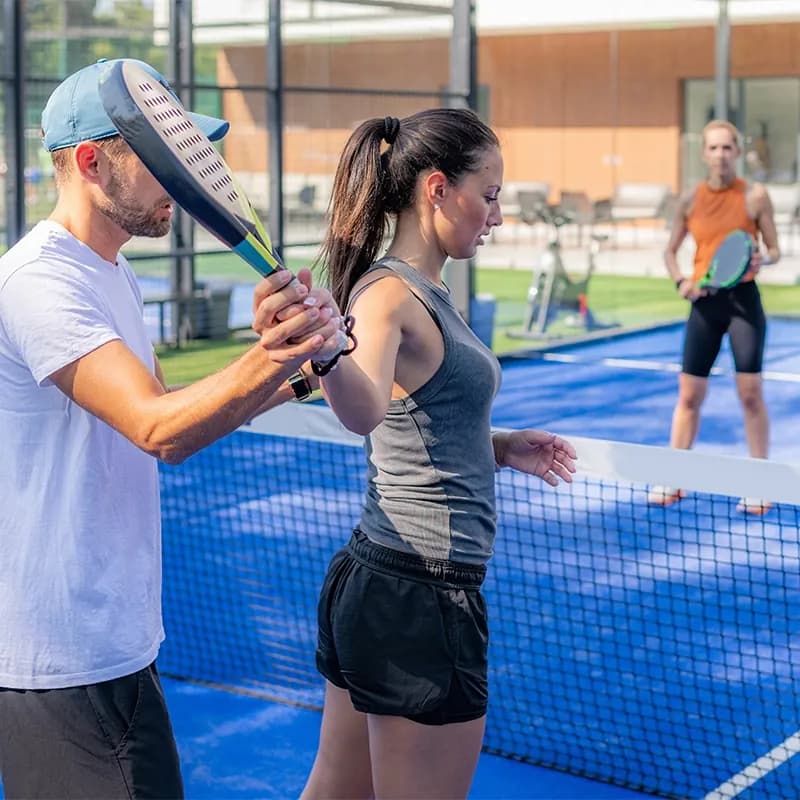
What Is Padel? A Beginner's Guide to the UK's Fastest-Growing Sport
Padel is the fastest-growing racket sport in the UK. In 2025 the LTA reported more than 860,000 people playing across 1,553 courts, and the numbers keep climbing. If you’ve seen glass-walled courts popping up at your local club, gym car park or rooftop venue and wondered what all the noise is about, this guide is for you.
In the next 8 minutes you’ll learn what padel is, how it differs from tennis, the rules in plain English, what equipment you need, how much it costs in the UK, and exactly what to expect from your first session. No jargon, no fluff — just everything a beginner actually needs.
Contents
- What is padel? The 30-second answer
- Padel vs tennis vs squash vs pickleball
- The padel court explained
- Padel rules and scoring, simplified
- How a padel point actually plays out
- Equipment you need to start
- Your first session: what to expect
- Common beginner mistakes (and easy fixes)
- How much does padel cost in the UK?
- Is padel really that popular in the UK?
- Where to play padel in the UK
- FAQ
What is padel? The 30-second answer
Padel is a doubles racket sport played on an enclosed glass-walled court about a third the size of a tennis court. You serve underarm, score it like tennis (15, 30, 40, game), and the ball can bounce off the back and side walls — a bit like squash. Points are long, rallies are tactical, and the rules are simple enough to pick up in one session.
It’s sociable, easy to start, and surprisingly hard to master. That combination is exactly why padel has exploded from a niche sport to the most-played racket sport in Spain, Sweden and growing fast in the UK.
Quick summary: doubles only (almost always), underarm serve, tennis scoring, walls are in play, rackets are solid with no strings, balls are slightly softer than tennis balls.
Padel vs tennis vs squash vs pickleball
Padel borrows ideas from tennis, squash and pickleball — but it isn’t any of them. Here’s a side-by-side at a glance:
| Feature | Padel | Tennis | Squash | Pickleball |
|---|---|---|---|---|
| Format | Doubles (almost always) | Singles or doubles | Singles | Singles or doubles |
| Court size | 20m × 10m, enclosed | 23.77m × 10.97m | 9.75m × 6.4m | 13.41m × 6.1m |
| Walls in play? | Yes (glass + mesh) | No | Yes (all walls) | No |
| Racket | Solid, perforated, no strings | Strung | Strung, small | Solid paddle |
| Ball | Softer than tennis | Tennis ball | Small rubber ball | Plastic wiffle ball |
| Serve | Underarm, after bounce | Overhead | Overhead | Underarm |
| Scoring | 15-30-40-game | 15-30-40-game | Rally scoring (PAR 11) | Rally to 11 |
| Learning curve | Very easy | Moderate–hard | Moderate | Very easy |
The short version: if you’ve played any racket sport, you’ll feel competent in padel within 30 minutes. If you haven’t, you’ll still have fun rallies in your first session — something you can’t say about tennis.
The padel court explained
A padel court is 20 metres long by 10 metres wide, enclosed on all four sides by a mix of glass walls (at the ends and lower sides) and metal mesh fence (upper sides). The net is 0.88m high in the middle and the court is usually sand-dressed artificial turf — so padel-specific shoes with herringbone soles grip much better than trainers.
The three key lines to know:
- Service line — 3m from the back wall. You serve from behind this line.
- Centre service line — splits the service box into left and right halves.
- Back wall — fully in play. You can hit the ball off your own back wall back over the net, or let your opponent’s shot rebound off it before you return.
That last bit is the magic of padel: the walls turn what would be a lost point in tennis into the start of a new rally.
Padel rules and scoring, simplified
Scoring
Padel uses tennis scoring: 0 (love), 15, 30, 40, game. Sets are first to 6 games with a 2-game margin; at 6–6 you play a tiebreak to 7. Many clubs and pro tours use golden point at deuce — one sudden-death point, receivers choose the side.
The serve (this is where beginners trip up)
- Bounce the ball, then hit it underarm.
- Contact must be at or below waist height.
- One foot on the ground, both behind the service line.
- Serve diagonally into the opposite service box.
- After the bounce in the service box, the ball may touch glass and still be live — but if it hits the metal fence, it’s a fault.
You get two serves, just like tennis.
In-play rules
- The ball must bounce on the floor first before hitting any wall. Any shot that hits your wall before the ground = point to opponents.
- After a bounce, the ball can hit any combination of glass and fence on your side and stay live — play it off the wall if you can.
- You cannot volley the return of serve. It must bounce first. After that, volleys are fair game.
- A ball that lands in court then flies out over the fence? Still in play if you can run outside the court and hit it back — some venues even allow this, which leads to ridiculous highlight-reel points.
That’s genuinely 90% of the rules. You can play your first match knowing only what’s in this section.
How a padel point actually plays out
Here’s a typical rally, narrated so you can picture it:
- Server bounces the ball, hits an underarm serve diagonally into the service box. It kicks up off the sand-dressed turf.
- Returner lets it bounce once (mandatory), then plays a deep lob over the server’s head to push the serving team back.
- The lobbing team sprints to the net — because in padel, the team at the net wins most points.
- The serving team retreats, lets the ball bounce off the back glass, then plays a defensive return straight up the middle.
- The attacking team volleys or plays a bandeja (a controlled overhead) to keep their opponents pinned at the back.
- Rallies continue, often 15–30 shots, until someone hits a winner off the glass or makes an unforced error.
The pattern — get to the net, stay at the net, force errors — is the heartbeat of padel strategy.
Equipment you need to start
The great news: almost every UK club offers racket hire for free or £3–5 per session. You don’t need to own anything to play your first game. When you’re ready to buy:
- Racket — solid, no strings, with a perforated face. Beginner rackets are round-shaped (biggest sweet spot, most forgiving). UK price: £50–120 for a good first racket. Avoid cheap supermarket rackets — they feel dead.
- Balls — padel balls look like tennis balls but have slightly lower pressure. A tube of 3 costs £5–7.
- Shoes — this matters more than the racket for beginners. Padel or clay-court shoes with herringbone or hybrid soles grip the sand-dressed turf. Running shoes will slip. UK price: £60–120.
- Clothing — whatever you’d wear for tennis. No dress code at public clubs.
Total beginner kit budget: £120–250. Or just rent everything and spend £0 up front.
Your first session: what to expect
Booking your first court can feel daunting. Here’s exactly what happens:
- Book a court. Most UK clubs use Playtomic, MATCHi, ClubSpark or their own system. Playskan aggregates all of them so you can find and book courts in seconds across 360+ UK clubs.
- Arrive 10 minutes early. Check in at reception, grab rental rackets and a tube of balls, and find your court.
- Warm up cooperatively. Hit a few forehands, backhands, volleys and lobs with your opponents — the warm-up is friendly, not competitive.
- Play. Decide who serves first (a racket spin works), agree whether to use golden point, and go.
- Rotate, repeat, laugh a lot. First sessions are messy. That’s the point.
Pro tip: book 90 minutes for your first game rather than 60. You’ll want the extra time to figure out the walls without feeling rushed.
Common beginner mistakes (and easy fixes)
- Volleying the return of serve. You can’t. Let it bounce.
- Standing too close to the back wall. Give yourself 1–2 metres so the ball can bounce off the glass and you can play it cleanly.
- Trying to smash every high ball. The bandeja (controlled overhead) is the real weapon — keep the ball in play and force errors instead of going for winners.
- Staying at the back. If you’re not at the net, you’re losing. Move up after every defensive shot.
- Forgetting to lob. A good lob against opponents at the net is the single most effective shot in beginner padel.
Fix even two of these and you’ll win more games than most first-year players.
How much does padel cost in the UK?
UK padel pricing varies dramatically by city:
- Cheapest UK courts: around £11/hour at venues like Padel People Basingstoke or clubs in Torquay.
- Average UK court hire: £20–40 per court per hour (split 4 ways that’s £5–10 each).
- London peak rates: £60–100/hour at central venues like Padium Canary Wharf.
- Lessons: £25–50 per person for a group coaching session.
We’ve analysed pricing across 360+ UK clubs in our full UK price guide and a London-specific breakdown.
Is padel really that popular in the UK?
Yes — and growing faster than any other racket sport. Here are the 2025 LTA headline numbers:
- 860,000+ people played padel in the UK in the past 12 months.
- 1,553 courts across the UK, up from ~50 in 2020.
- 43% of adults now recognise padel as a sport (up from single digits in 2020).
- The LTA is targeting 1,000 courts in London alone within the next few years.
Every major UK city now has padel clubs, and 2,000+ new courts are in planning or construction across the country. Clubs are booked solid in peak hours. Padel is no longer niche — it’s arguably the fastest-growing participation sport Britain has ever seen.
Where to play padel in the UK
Padel is now available in every major UK city. To find courts near you:
- All UK padel clubs — browse 360+ venues nationwide.
- Padel in London — 46+ clubs with live availability.
- Padel in Manchester
- Padel in Birmingham
- Padel in Edinburgh
- Padel in Glasgow
- Padel in Nottingham
- Padel in Sheffield
Playskan pulls availability from Playtomic, MATCHi, ClubSpark, Padel Mates and more into one search — so you can see every free court in your city without bouncing between five apps.
FAQ
Is padel easy to learn? Yes. Most players have fun rallies in their very first session. Beginners who’ve played any racket sport — tennis, squash, badminton, even table tennis — typically pick up the basics in 15–30 minutes.
Do I need to have played tennis first? No. Padel is arguably easier to learn from scratch than tennis because the serve is underarm, the court is smaller, and the walls keep the ball in play for longer.
Can you play padel as singles? There are singles padel courts (narrower), but they’re rare. Almost all padel is doubles — the format is designed for it.
What should I wear? Sports clothing and padel or clay-court shoes (herringbone sole). Avoid running trainers — they’ll slip on the sand-dressed turf.
How long is a padel match? A best-of-three-set match typically takes 60–90 minutes. Most casual bookings are 60 or 90 minutes.
What’s the difference between padel and padel tennis? They’re the same sport. “Padel tennis” is an older name — the correct term is just padel.
Is padel an Olympic sport? Not yet. Padel is recognised by the International Olympic Committee and is being considered for future Games, but it’s not currently on the Olympic programme.
Padel vs pickleball — which is better? Different sports. Pickleball is faster to learn, plays indoors on a hard court, no walls. Padel has longer rallies, more tactics, walls in play. Padel is the bigger sport globally; pickleball is huge in the US. Try both.
How many balls do I need? One tube of three balls covers a full match.
Can kids play padel? Absolutely. Many UK clubs run junior programmes from age 6 upwards.
Ready to play?
Padel really is as fun as everyone says. The best way to find out is to get on court.
Find and book your nearest padel court with Playskan →
We aggregate live availability from every major UK booking platform into one search, so you’re never more than a few clicks away from your first game.
Sources & Further Reading
- LTA Padel – How to get started – official UK beginner guide.
- LTA Padel – Rules – authoritative UK rules.
- FIP – Official Rules of Padel – international rules PDF.
- LTA – 860,000 players stat – latest UK participation numbers.
- Playskan Padel Rules & Etiquette – deeper on rules, serving and on-court etiquette.
- Playskan Padel Glossary – 80+ padel terms explained.