Data Analysis · Industry
Where to Build a Padel Club in the UK
Occupancy falls from 69% to 56% as local courts pile up, 509 applications are awaiting a decision, and half of 2026's outdoor openings were under half booked in summer. Five filters for a UK padel site, from 815 tracked clubs.
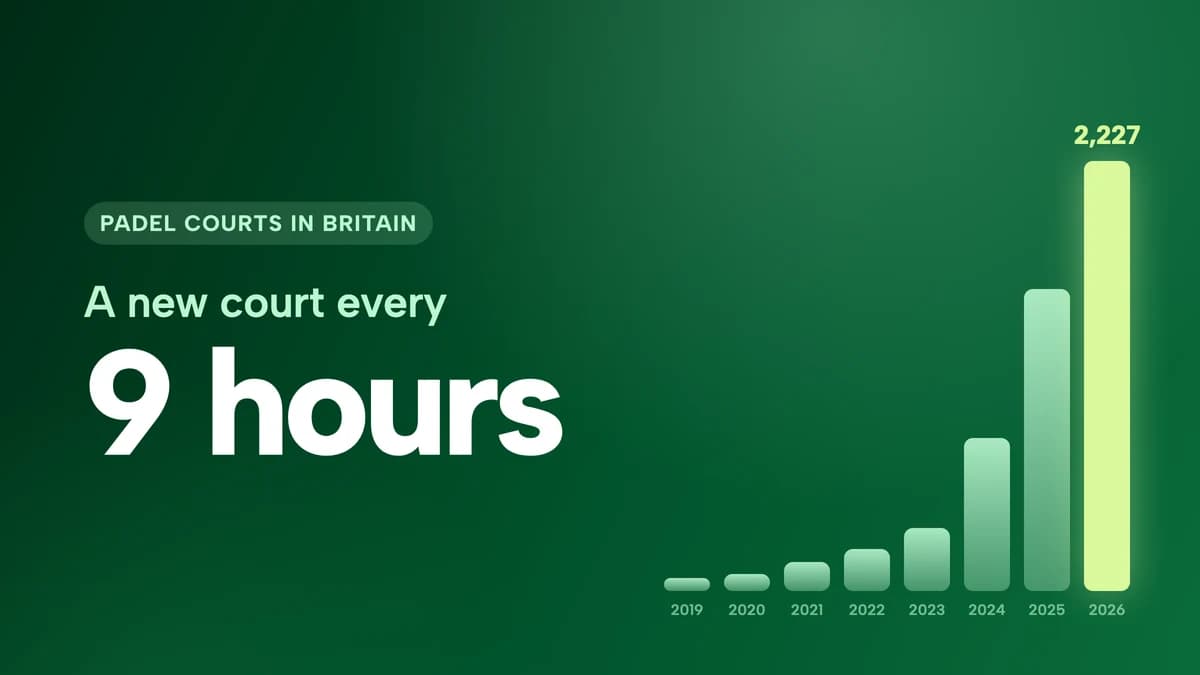
The UK opens a new padel court roughly every eight hours, and the national question — is there demand? — is settled. The question that decides whether a site makes money is entirely local, and almost nobody underwrites it properly.
We track every padel club in the UK every day: 815 clubs and 2,819 courts as of October 2026, plus 2,807 planning applications filed since the sport arrived here. That dataset will not tell you whether a specific site is a good investment. It will tell you, quickly and cheaply, which sites to stop looking at.
Here are the five filters we would apply, in the order that eliminates the most sites for the least work.
1. Local supply, not national growth
This is the finding that does the most work, and the one least visible from inside a single club.
Group established clubs by how many padel courts already sit within 10 miles of them, per 10,000 people living in that same radius, and occupancy falls in a straight line.
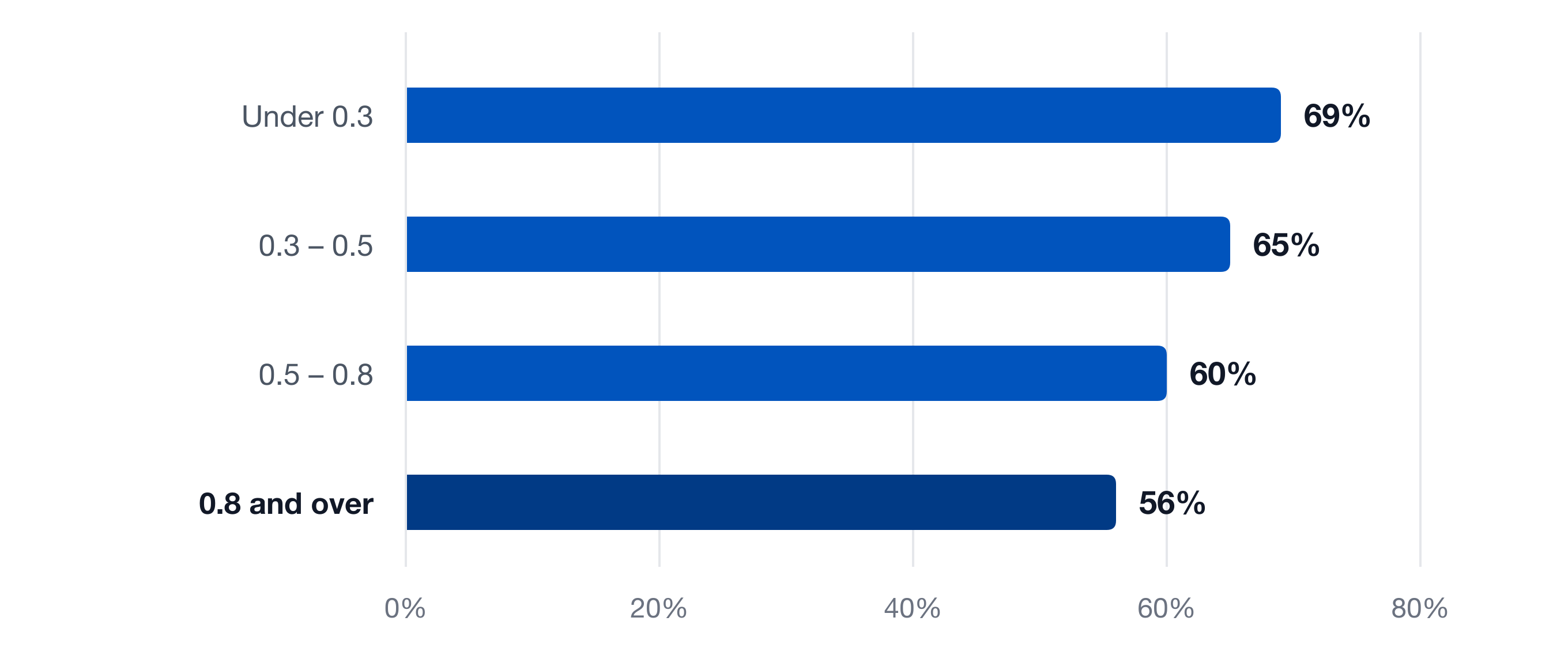
That thirteen-point spread is roughly the difference between a strong asset and a marginal one, and it is not an artefact of young clubs still ramping: about a quarter of clubs opened in 2026 in every density band.
There is still a lot of empty map. 81 of Britain's 350 local authorities have no padel club at all. Most of them are empty for a reason — population, income, travel times — but not all of them.
Note what the bands above are measured over, because it matters: a 10-mile radius around the club, not its council area. A district boundary is not a catchment — a club three miles away across an administrative line competes with you exactly as hard as one on your own high street. Council averages are the wrong unit for this question, and they flatter dense urban boroughs in particular.
2. Price in the pipeline, not the map
The map of clubs open today is the wrong map. The UK has 509 padel planning applications sitting undecided right now, and on the record so far 87% of decided applications are approved — councils take an average of 124 days to decide.
Then, across 229 clubs we can match to their founding application, the timeline is remarkably consistent:
| Stage | Median |
|---|---|
| Application → approval | 3 months |
| Approval → opening | 6 months |
| Application → opening | 9 months (7 indoor, 10 outdoor) |
So the club that will compete with you next summer is already a PDF on a council portal today. Counting approved-but-unbuilt schemes, and discounting them by the rate at which they historically convert, the pipeline is worth somewhere around 20–30% on top of today's court count — concentrated, not spread evenly.
Any site appraisal that measures competition as "clubs open today" is measuring a market that will not exist by the time you open.
3. Ask what a neighbour would do to you
We can measure this directly, because clubs keep opening next to other clubs.
When a bigger club opens within about two miles, the existing club loses roughly 1 in 16 of its bookings — and does not win them back. Open further away, or open smaller, and we cannot measure any effect at all.
The sample is small — tens of club pairs, not hundreds — so treat it as a warning rather than a coefficient. The asymmetry is the useful part: proximity alone is survivable, proximity plus being out-scaled is not. It cuts both ways, and it is the most common thing missing from a padel business plan.
4. A roof is not a nice-to-have any more
The market has already voted. 79% of the padel courts opened in the UK in 2026 have a roof, up from 54% in 2024. Planning tells the same story from the other end: indoor-building schemes rose from 6% to 28% of applications.
The reason shows up in the 2026 opening cohort.
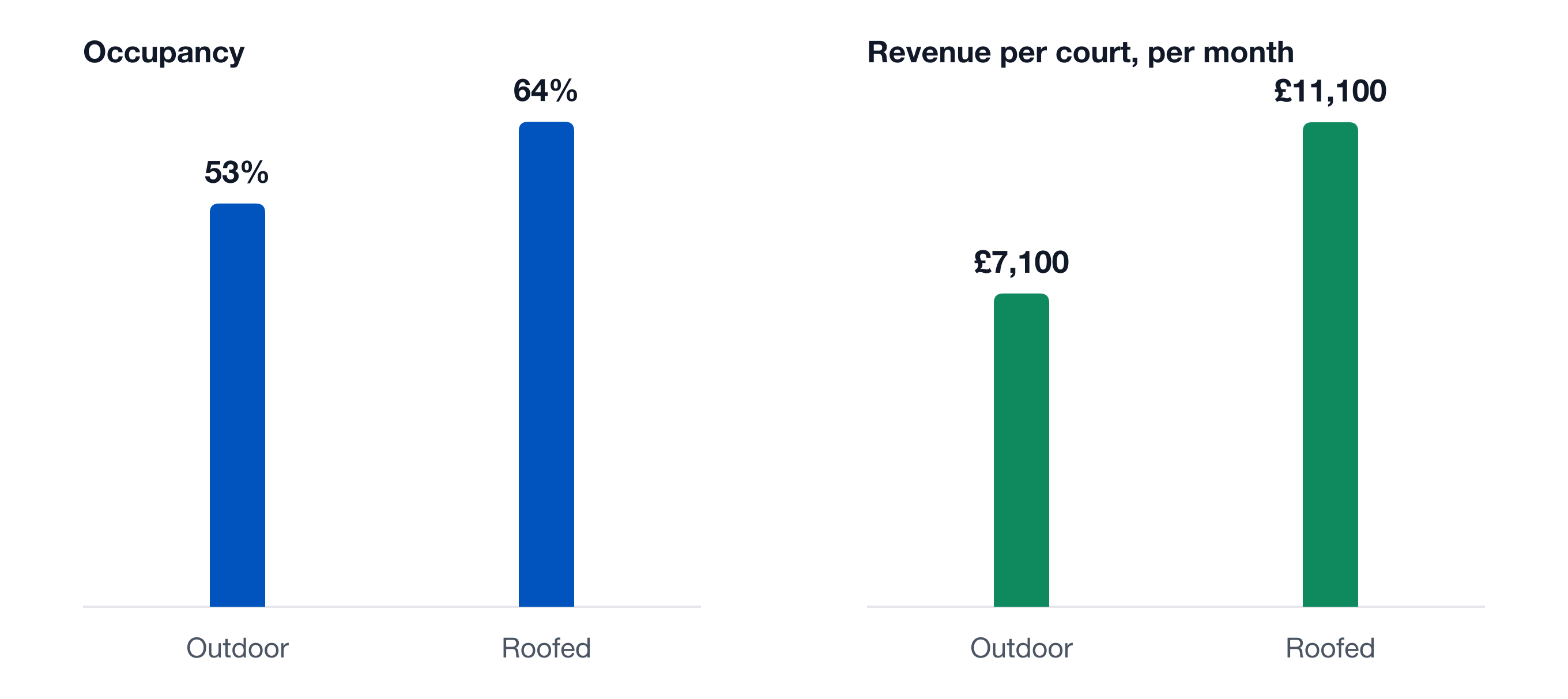
Nearly half of 2026's outdoor openings were less than half booked in the middle of summer. Roofed clubs opening in the same year sit at 64%, level with the roofed clubs that came before them. Weeknight evenings are full for everybody; the entire gap is daytime and weekends, which is exactly what weather takes away.
A canopy roughly doubles the build cost — the LTA's 2025 figures put a court at £67,000–£74,000 uncovered against £122,000–£166,000 covered — so this is a real trade, not a free upgrade. But it is now the trade that most distinguishes a full club from an empty one.
5. Underwrite the hours that actually pay
Two numbers worth holding together.
Mon–Thu 5–10pm is 18% of Britain's opening hours and 27% of its money, running at 90% occupancy. Weekday daytime is 46% of opening hours and 65% of all the empty court time in the country, at 49%.
Which means adding courts mostly adds daytime. A bigger venue does not proportionally buy more of the hours that pay — and in our roster, 7+ court venues run emptier than 3–6 court venues in every opening cohort without earning more per court.
It also means the market is already two-speed: almost a third of UK clubs are under 50% booked over the last 90 days, and they take a median £5,600 per court a month against £10,200 for everyone else.
One last thing, because the instinct is nearly universal: do not underwrite on a discount strategy. Clubs charging £40+ an hour run higher occupancy (65%) than clubs charging under £25 (56%), on about two and a half times the revenue per court. At this stage of the market, price is not what is constraining demand.
What this data cannot tell you
Everything above is measured: observed availability and observed prices, collected daily across Playtomic, MATCHi, Padel Mates, ClubSpark and the rest, with nothing self-reported by clubs.
But we only see the top line. We observe unavailability, not verified paid bookings — coaching and member blocks look identical from outside — so treat court-hire revenue as a ceiling. We see court hire only, so coaching, memberships and food and drink are invisible to us. And operating costs are not in any dataset we hold, which is awkward, because they are what decides profitability.
That is why you will not find a payback period on this page. Put the UK average revenue per court next to the LTA's build costs and the arithmetic implies payback in about a year, which is obviously wrong: it quietly treats gross booking value as profit. Anyone quoting you a padel payback period without a real operating cost base is doing exactly that.
The shortlist, in five questions
- How many padel courts already sit within 10 miles of this site, per 10,000 people in that catchment?
- How many live planning applications sit in the same radius, and how many courts do they carry?
- Is anything bigger than me likely to open within two miles in the next 18 months?
- Does the plan have a roof, and does the model survive if it does not?
- How many Mon–Thu evening court-hours does this site actually sell, and does the case close on those alone?
If a site fails questions 1 and 2, nothing else is worth costing.
Where to run the numbers
Playskan Insights is built to answer exactly these questions for a specific location:
- Padel Club Planner — opportunity scoring for every UK local authority, on catchment supply, demand and existing club performance
- Planning applications — the live UK pipeline, by authority, status and court count
- UK market report — national occupancy, pricing and growth, refreshed daily
- Build costs — what a court costs to put in the ground, sourced to the LTA
- Site finder — catchment, supply gap and demand signals for a specific address
Frequently asked questions
Where is the best place to build a padel club in the UK? There is no national answer, only a catchment answer. Occupancy falls measurably as local courts per head rise — 69% where there are under 0.3 courts per 10,000 people within 10 miles, 56% at 0.8 or more — and 81 of Britain's 350 local authorities still have no club at all. Score a 10-mile radius around the specific site, including the planning pipeline, rather than a council average.
Is padel still a good investment in the UK in 2026? The demand is real and still growing — the UK has about 4.1 courts per 100,000 people against roughly 35 in Spain. But the returns have clearly stopped being uniform. Almost a third of UK clubs are under 50% booked and take roughly half the revenue per court of everyone else, and that group skews outdoor, small and recently opened. Whether padel is a good investment is now a question about a catchment, not about the sport.
How long does it take to open a padel club in the UK? A median of nine months from planning application to opening — three months to a decision, six more to open the doors. Indoor schemes are faster (seven months) than outdoor (ten). About 87% of decided applications are approved.
Do padel courts need to be indoor to make money in the UK? Not necessarily, but the gap is now large. Clubs that opened in 2026 with a roof run 64% occupancy and roughly £11,100 per court a month; outdoor clubs from the same cohort run 53% and about £7,100, with nearly half under 50% booked in high summer. A canopy roughly doubles the build cost, so it is a genuine trade — but the market is choosing it, at 79% of the courts opened in 2026.