Data Analysis · Industry
How Much Revenue Does a UK Padel Club Make?
The average UK padel club books £38k of court time a month at 58% occupancy. Revenue per court, occupancy by local court supply, and LTA build costs — from 815 tracked clubs.
The average tracked UK padel club books around £38,000 of court time a month — roughly £10,400 per court. Across the country that adds up to an estimated £314 million a year.
That is revenue, not profit, and the distinction matters more than it might sound. We can measure what every padel court in Britain takes in bookings, because we watch all of them every day. We cannot see anyone's rent, staff bill, energy contract or debt service. So this article answers the revenue question precisely, sources the build-cost question properly, and is explicit about exactly where the profit question runs out of evidence.
The averages are also the least interesting part. Established clubs in the emptiest local markets run 69% occupancy; in the most crowded, 56%. That thirteen-point gap is the difference between a strong asset and a marginal one — and it is opening up right now, while courts go in the ground faster than ever.
All of the below comes from Playskan Insights, which tracks live availability and pricing at every padel club in the UK, every day — 815 clubs and 2,819 courts as of October 2026. Occupancy and revenue figures cover the 677 clubs with enough booking data, over the last 90 days. Nothing is self-reported by clubs and nothing comes from a survey.
How much revenue does a UK padel club generate?
The headline figures for the tracked market:
| Measure | UK average |
|---|---|
| Clubs tracked | 815 (677 with booking data) |
| Courts tracked | 2,819 |
| Average price | £34 per hour |
| Average occupancy | 58% (last 90 days) |
| Revenue per court | ~£10,400 per month |
| Revenue per club | ~£38,000 per month |
| Estimated market size | £314m per year |
Those figures are gross booking value on court hire, and they are wrong in two opposite directions at once, which is worth understanding before anyone builds a model on them.
They overstate paid court activity, because what we observe is a court being unavailable. Coaching, maintenance and member blocks look identical to a paid booking from the outside. Treat the number as a ceiling on hire income.
They also understate total club revenue, because court hire is all we see. Coaching income, memberships, food and drink, and retail are invisible to us, and at a well-run club they are not a rounding error.
The spread around the averages matters far more than the averages themselves — which is the real subject of the rest of this article.
The market is still accelerating
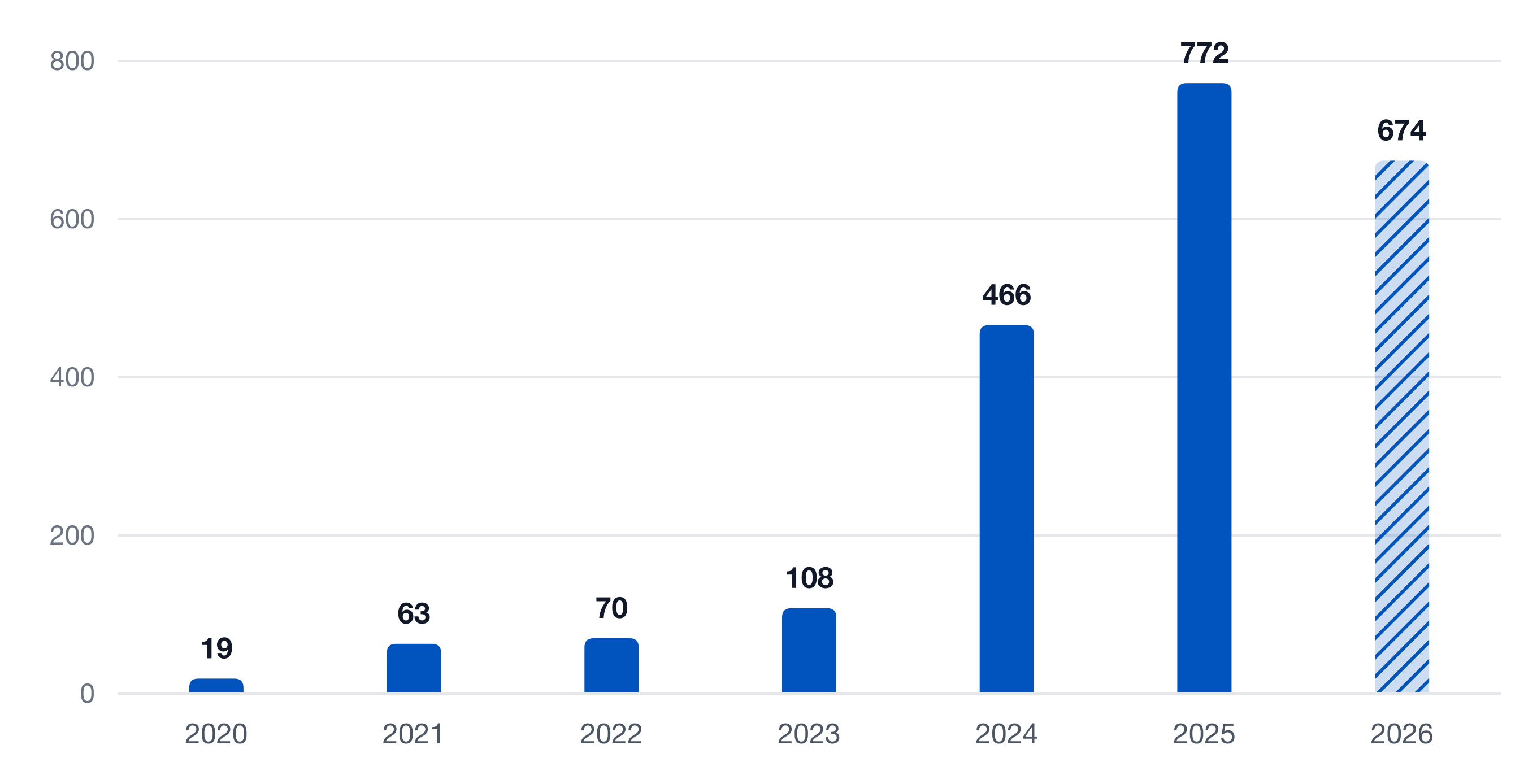
2023 is the hinge. Before it, padel in Britain was a niche adding a court every few days. After it, it became an industry: 466 courts in 2024, 772 in 2025, and an estimated 1,113 in the twelve months to mid-October 2026 — up 74% on the year before.
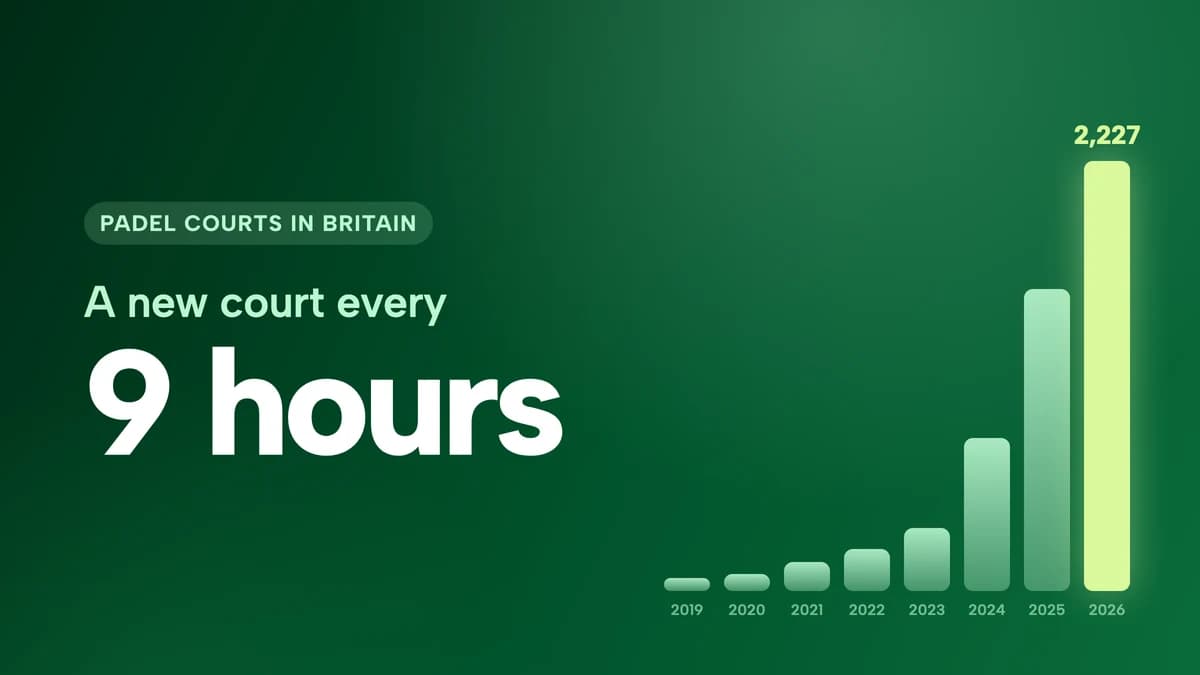
The 2026 bar looks shorter only because the year is not finished. Measured as a rate it is the fastest yet — one new court roughly every eight hours, against one every eleven hours in 2025 and one every 3.4 days in 2023.
For anyone deciding whether to enter, that is the number that should set the clock. Supply is arriving faster than any of the demand forecasts written in 2023 assumed.
Local saturation is now measurable
This is the finding we get asked about most, and the one that is hardest to see from inside a single club.
Group established clubs by how many padel courts already sit within 10 miles of them, per 10,000 people living in that same radius, and occupancy falls in a straight line.
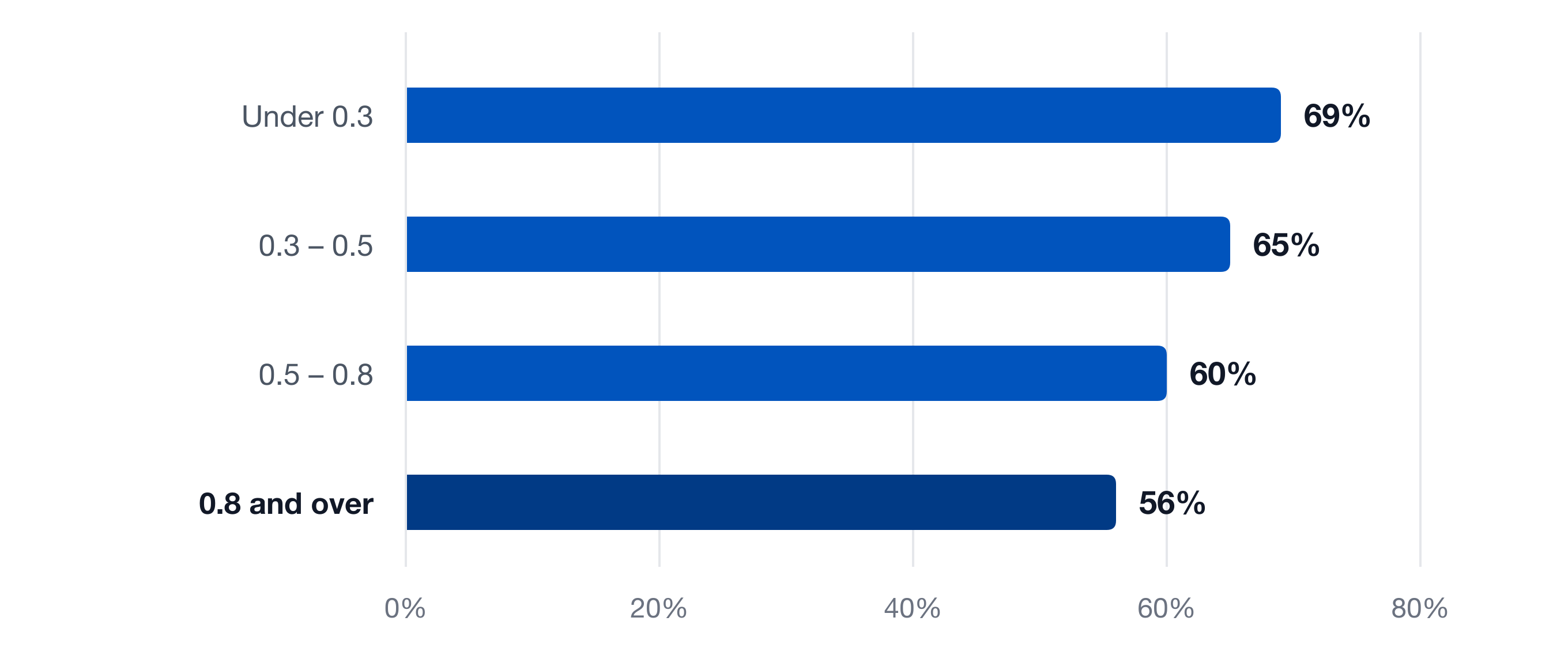
The obvious objection is that dense areas are simply full of new clubs still ramping up. They are not. Roughly a quarter of clubs opened in 2026 in every density band, so the gradient is not an artefact of young clubs — it is supply.
At the current build rate, a lot of catchments will cross that 0.8 threshold within the next eighteen months. Most of the people signing leases today have never seen their own catchment's number, because until recently it did not exist.
Working out where your target town sits on that curve is, in our view, the single highest-value question in UK padel right now.
The cheapest clubs are not the fullest
Ask most operators what fills courts and they will say price. The data says otherwise.
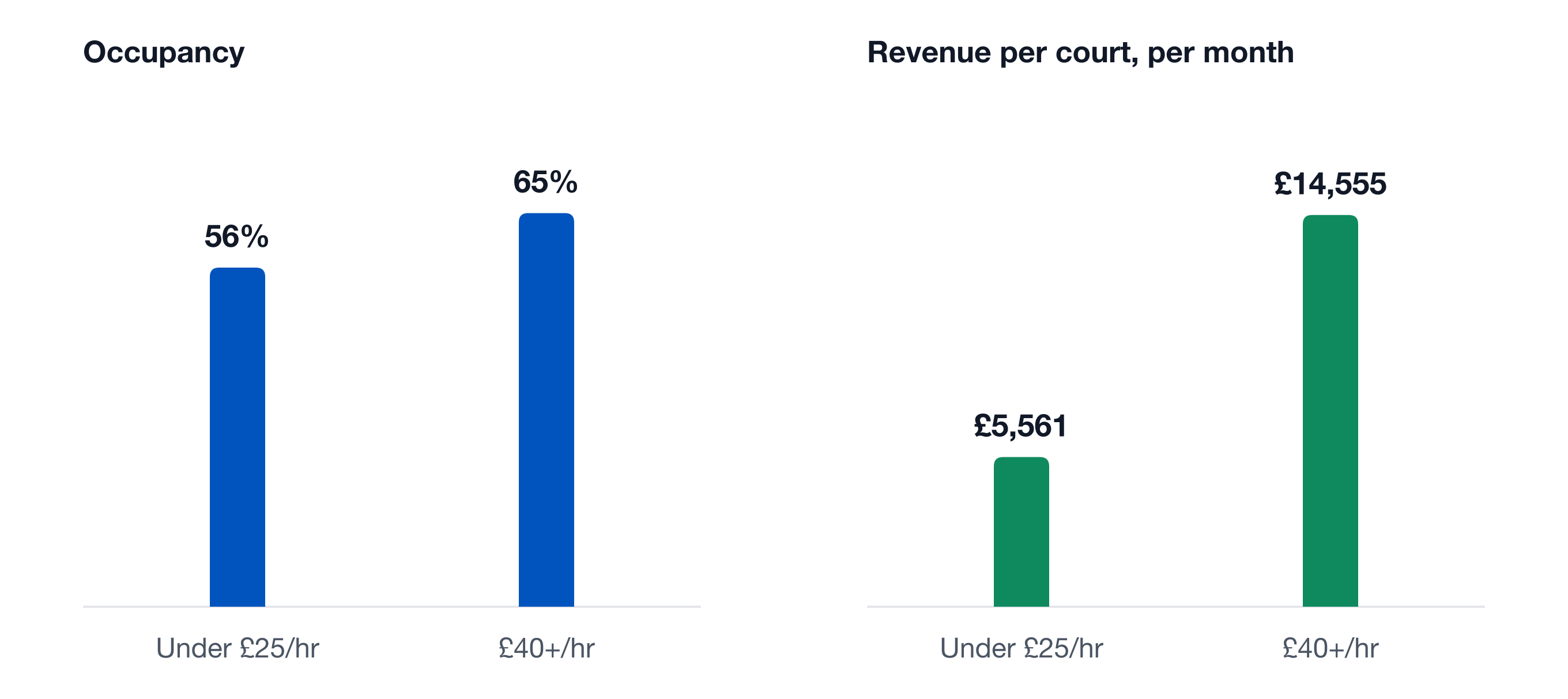
Clubs charging £40+ an hour run 65% occupancy. Clubs charging under £25 run 56% — emptier, on well under half the revenue per court.
Price is clearly not the constraint on demand at this stage of the market. Location, court quality and whether there is a roof are all doing more work than the hourly rate.
The pricing instinct that costs operators money
That cross-section raises an obvious question: does occupancy actually respond to price at all, or are expensive clubs just better clubs in better places?
We can answer it properly, because we record prices daily and clubs change their own prices constantly. That gives us a natural experiment — thousands of real price changes, each comparable against matched courts at the same club that did not change.
We ran that study across 2,255 clean price changes at 185 clubs, with placebo and pre-trend checks to make sure we were measuring the price change rather than the reason behind it.
The finding, without the full table: the near-universal instinct to discount quiet hours is revenue-negative, and the effect is strongest exactly where operators are most tempted to use it. Meanwhile the busiest hours behave in a way that suggests most UK clubs are leaving money on the table at peak.
The direction surprises nearly everyone we show it to, and the size of it varies enormously by club. The full elasticity breakdown — and what it means for a specific club's own price list — sits inside Playskan Insights.
Rain does not cancel padel, it relocates it
One more, because it changes how people think about covered courts.
Joining occupancy against daily weather across more than 50,000 club-days: on wet days outdoor occupancy falls from 71% to 57%, while indoor occupancy over the same days goes from 74% to 75%.
British weather does not destroy padel demand. It moves it under a roof. A covered court is not just a nicer product — it captures the demand your outdoor competitor is losing.
What it costs to put a court in the ground
Revenue is only half of any real decision, so here is the half we can source properly — and the half we cannot.
Capex is sourced. The LTA's Padel Court Construction Guidance Note (2025) publishes delivered project costs from real 2025 builds. Per court, that comes out at roughly £67,000–£74,000 uncovered, rising to £122,000–£166,000 with a canopy. Per-court cost falls as you build more, because fixed groundworks spread across a bigger scheme. Those figures exclude VAT and fees, land, planning, professional fees, the outer play area, and fully enclosed indoor halls — a full indoor build is a different and larger number.
On running costs the same guidance gives two usable anchors: LED lighting at roughly £1 per court per hour, and a recommended sinking fund of £1,500 per court per year against resurfacing every five years or so.
Operating costs are not sourced, and we will not invent them. Rent, staff, energy contracts, platform commission and marketing vary enormously by site and are not visible in any dataset we hold. That is the missing term, and it is the term that decides profitability.
This is why you will not find a payback period or an ROI figure anywhere on this page. Put our average revenue per court next to the LTA's capex range and the arithmetic implies a payback of around a year, which is obviously wrong — it silently treats gross booking value as though it were profit. Publishing that number would get us cited, and it would be false. Anyone quoting you a padel payback period without a real operating cost base is doing exactly that.
How we measure all this
Everything above comes from observed booking availability and observed prices, collected daily across every major UK booking platform — Playtomic, MATCHi, Padel Mates, ClubSpark and the rest.
That independence is the point, and the limits are worth stating plainly:
- We observe unavailability, not verified paid bookings — so hire revenue is an upper bound, as above.
- Occupancy uses a fixed 90-day window with per-date court counts, so a club adding courts mid-period does not gain phantom capacity.
- Clubs too new or too sparsely tracked to be reliable are excluded from aggregates rather than smoothed over.
Most padel market numbers in circulation come from press releases. We would rather publish a figure with its error bars attached.
What is in Playskan Insights
Playskan Insights is the market intelligence product built on that dataset:
- Club benchmarks — occupancy, pricing, estimated revenue and competitive rank for any tracked UK club
- Market reports — national, city and local-authority views, including the court-density picture above
- Planning pipeline — padel planning applications by authority, so you can see supply before it opens
- Site selection — catchment, supply gap and demand signals for a specific location
Club owners use it to price against their real local market instead of a guess. Operators use it to choose the next town. Investors use it for diligence on assets that otherwise come with no independent numbers at all.
The free court search for players stays free. It is how we see the market in the first place.
Frequently asked questions
How much revenue does a UK padel club generate? The average tracked UK club books around £38,000 of court time a month, or roughly £10,400 per court, at 58% occupancy over the last 90 days. That is gross booking value on court hire only — it excludes coaching, memberships and food and drink, and it counts any hour a court is unavailable rather than only paid bookings.
How much revenue does a single padel court generate? Around £10,400 per court per month on average. Clubs charging £40+ an hour average roughly £14,600 per court, while clubs charging under £25 an hour average closer to £5,600 — the price band matters more than most operators expect.
Is padel profitable in the UK? We can't answer that from measurement alone, and we'd be suspicious of anyone who says they can. We measure revenue precisely and the LTA publishes credible build costs, but operating costs — rent, staff, energy, commission — are not available in any dataset, and they are what decide profitability. What the data does show is that revenue varies enormously by location and price band, so the question is far more site-specific than a national answer would suggest.
What does it cost to build a padel court in the UK? Roughly £67,000–£74,000 per court uncovered, or £122,000–£166,000 with a canopy, per the LTA's 2025 construction figures. That excludes VAT and fees, land, planning, professional fees and fully enclosed indoor halls.
What is a good occupancy rate for a padel club? The UK average is 58% over the last 90 days. Established clubs in the least crowded catchments average 69%; in the most crowded, 56%. If you are well below 60% in a catchment with fewer than 0.5 courts per 10,000 people, local competition is probably not your problem.
How many padel courts are there in the UK? We track 2,819 courts across 815 clubs as of October 2026, with a new court opening roughly every eight hours. Current figures are on the UK market report.
Where is the best place to build a padel club in the UK? Occupancy falls measurably once there are more than about 0.8 padel courts per 10,000 people within 10 miles. Catchments below 0.3 sustain around 69% occupancy; above 0.8, around 56%. Local supply, not national growth, is the binding constraint.